IMPHAL, Oct 6: 28 Assam Rifles Lilong Post has saved a snake bite victim identified as one Sobita Devi, 31, wife of H. Hemanta, VillageArapati who was bitten by a snake while she was working in the paddy fields.
A release has stated that the lady was given anti venom and first aid by the Nursing Staff of 28 AR post saving the life of the person who was in a dire state.
The villagers of Arapati were thank full and grateful to the 28 AR post for providing the timely assistance, care and life saving drugs, the absence of which would have proved lethal to the person’s life, added the release.
Author Archives: Jason W
18 foot Burmese python snake saved from burning Rhode Island home
A house in Rhode Island caught fire and apart from the occupants of the house there was an 18-foot Burmese python as well, who inhabited the house. The homeowner also had other pets in the form of two dogs and a cat. However he was lucky enough to escape the burning inferno and had also carried his dogs and cat to safety. However the 18-foot Burmese python was stuck in the fire.
Firefighters swung into action and managed to rescue the snake from the burning house. Chief Peter Henrikson said that when they saw the snake, then they were shocked because its midriff was as wide as a Frisbee. He also said that he didn’t even go near the snake, as he suffers from a snake phobia. However his team members were braver and they got the snake to safety.
According to reports the fire started because the exhaust pipe of a wooden stove was resting against a wall.
Tucker the Turtle hitches home

We’re glad to hear that Tucker the Eastern Box Turtle has found a ride back to his old Kentucky home.
Winter’s coming, and the poor little homeless reptile would probably feel out of sorts north of the Mason-Dixon line when the snow flies.
Not that he’d be stuck in a snow drift or anything. The folks at the Animal Humane Society would have taken care of that.
But still, they felt it best that Tucker head home after he was handed off by a Good Samaritan trucker who found him in the road with a cracked shell. So they put out a call for a ride.
By the afternoon, Tucker was a bona fide media star, and he had a driver: Greg Staffa, a Farmington guy with a serious do-gooder streak who’s known homelessness himself, and who’s really into the whole Twitter thing:
“With foreclosures, job loses and more I think we can all relate to a Turtle Named Tucker. Just a little guy needing a hand to get home,” he says.
And so on Saturday, Tucker and Staffa hit the road for the Broadbent Wildlife Sanctuary in Irvington, Ky. It’s a good long haul:
Calif. scientists find ‘social’ lizards
SANTA CRUZ, Calif., Oct. 6 () — Researchers say a species of lizard in California deserts lives in family groups, showing patterns of social behavior more commonly seen in mammals and birds.
Scientists at the University of California, Santa Cruz, say their research into the formation and stability of family groups in desert night lizards (Xantusia vigilis) in the Mojave desert provides new insights into the evolution of cooperative behavior, a university release said.
Alison Davis, who led the study as a graduate student at UC Santa Cruz, said one of the unusual characteristics of desert night lizards is that they are viviparous, giving birth to live young instead of laying eggs.
But even more unusual, she said, was that both young and old lizards could be found huddling together every winter beneath fallen Joshua trees and other desert plant debris.
“This is remarkable, given the fact that in most species of lizards, individuals actively avoid each other,” Davis said.
The researchers found that young desert night lizards stay with their mother, father, and siblings for several years after birth, and some groups aggregated under the same fallen log year after year, forming what the researchers termed dynasties.
The fact the young are born live, rather than hatching from eggs, is crucial for the evolution of cooperative behaviors, Davis said.
It “provides the opportunity for prolonged interaction between the mother and offspring, which predisposes the animal to form a family group,” Davis said. “The importance of parent-offspring interaction fits with what is currently understood about evolution of family groups and cooperative behaviors in birds and mammals.”
Oil spill turtles begin winter hibernation
CALHOUN COUNTY, Mich. (WZZM)- Most of the 2,000 animals captured after the Michigan oil spill are turtles and it turns out the hardy reptiles are fighters.
Wildlife workers have rehabilitated several hundred turtles and released them back into the wild. About 300 turtles will remain in care for the winter at a makeshift rehabilitation center in Marshall. Caretakers will keep them in warm conditions to break the natural hibernation cycle.
Chris Tabaka with the Binder Park Zoo says, “They’re going to lose one hibernation cycle, it’s not like we’re keeping them out of hibernation year after year. It’s shouldn’t slow them down in the least, and of course we’re going to fatten them up all winter long, so they’ll be ready to go during their reproductive cycles in the springtime.”
The turtles will be released back into the wild when they emerge from hibernation in the spring.
Teen Wants Sale Of Small Turtles In Denver To Stop

A reptile rescue group has a warning about minature pet turtles which are being sold along some Denver streets. They may be cute, but the turtles are expensive to care for and illegal in many cases.
Tents selling the turtles have been popping up all over the Denver metro area. CBS4 went to one on Federal Boulevard and Florida, where street vendors were selling them for rock bottom prices. Sadie Bustam, 13, told CBS4 she got hers for $10.
Experts say a turtle of such a small size won’t survive cold winter temperatures without a $300 thermal tank.
Federal law also prohibits the sale of turtles less than 4 inches long because of the possibility of salmonella poisoning. Some children might be tempted to put their mouths on the small creatures.
Bustam said she wants vendors to stop selling the animals.
“I want them to be totally gone, the stands, and them to get in trouble for doing it,” she said.
The vendors always seem to close up shop before authorities can get to them.
Rocky Mountain Reptile Rescue is taking in some of the animals.
200 new species discovered in 60-day expedition in New Guinea
Posted on
by
 Posted in Amphibians, Conservation, Foreign News, Reptiles, Snakes, Turtles, U.S. News
Leave a comment
Posted in Amphibians, Conservation, Foreign News, Reptiles, Snakes, Turtles, U.S. News
Leave a comment
Posted in Amphibians, Conservation, Foreign News, Reptiles, Snakes, Turtles, U.S. News
Leave a comment

A 2009 expedition to Papua New Guinea proves once again that the island-nation is as diverse in life as it is in human cultures. It took researchers with Conservation International (CI) and the local Institute for Biological Research (IBR) just two months to uncover a startling 200 new species: averaging more than 3 a day in the remote Nakanai Mountains and Muller Range rising from the island of New Britain, a part of Papua New Guinea. Half of the new species were spiders, but the team also found two new mammals, nine new plants, two dozen frogs, and multitude of insects. Most surprising was the discovery of at least two species so unique that they are likely to be assigned their own genus.
“There’s no question that the discoveries we made in both surveys are incredibly significant both for the large numbers of new species recorded, and the new genera identified,” said Leeanne Alonso, head of CI’s Rapid Assessment Program (RAP) which sends scientists on brief expeditions into biodiverse areas that have been largely unsearched by researchers. Since its first expedition in 1990, RAP has uncovered over 700 new species.
 This spiny ant from the Muller Range likely represents a new genus. Found in the canopy of a fallen tree at mid-elevation (1600m), RAP entomologist Andrea Lucky suspects that these ants survive high in the trees. This discovery proves that much remains to be learned about the arboreal ants of the region. Photo: © Andrea Lucky. |
On this expedition in the Nakanai Mountains experts found a unique high-altitude mouse with a half white, half black tail. With no close relatives to date identified, researchers are creating a new genus for the tiny rodent.
Entomologists also uncovered a variety of new ant species, including an ant sporting remarkable spins on its back. Researchers believe the new ant, of which they only found two individuals, actually lives high in the forest canopy. Like the mouse, the new ant is so different that researchers think it belongs to its own genus: DNA studies on species are underway.
Another notable discovery was a two centimeter long frog from the ceratobatrachid family. The new tiny amphibian was surprising because until now these type of frogs were only known from the Solomon Islands.
Researchers were especially attracted to the Nakanai Mountains and Muller range given that both have been nominated for UNESCO World Heritage status by the federal government’s Department of Environment and Conservation.
“We hope that news of these amazing new species will bolster the nomination of these spectacular environments for World Heritage status,” said expedition team leader Stephen Richards.
 This tiny frog belongs to group previously known only from the Solomon Islands, making its discovery on New Britain a complete surprise. The frog calls in the late afternoon, especially after drenching rainfall, a common occurrence. © CI/photo by Stephen Richards |
Once protected by its remoteness and wild geography, Papua New Guinea’s people and species are facing new threats, as well as new opportunities. Logging and palm oil industries are putting pressure on tribes and the governments to clear forests for income, while big development projects, such as mines, imperil ecosystems. For now, however, Papua New Guinea remains one of the most untouched nations in the eastern hemisphere.
“[These new species] should serve as a cautionary message about how much we still don’t know about Earth’s still hidden secrets and important natural resources, which we can only preserve with coordinated, long-term management,” said Alonso.
Collaborating with CI was A Rocha International (ARI), a Christian-oriented NGO devoted to conservation.
“As Christians, we believe we are called to care for creation and ensure that life on Earth is protected and respected, no matter how seemingly insignificant a particular species might appear to be,” said Sir Ghillean Prance, chair of the A Rocha International Board. “We also believe that we have a responsibility to help the poorest members of society, whose needs very often go hand in hand with natural resources, as it is usually the poorest people who live most closely to nature and depend on it for their daily needs.”
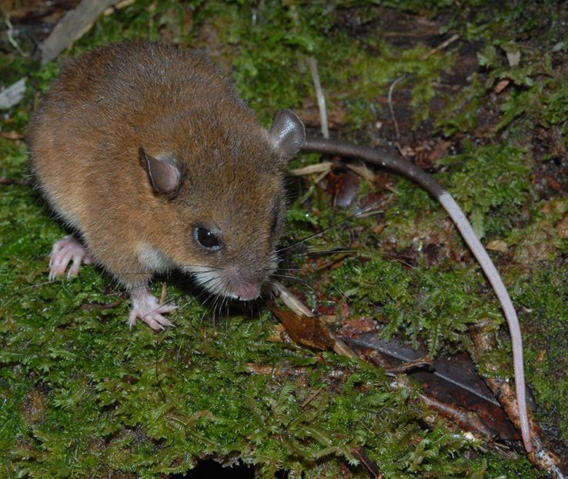
Although this new mouse species resembles the prehensile-tailed tree mice of New Guinea, researchers believe this mountain mouse has no close relatives, representing a new genus. © CI/photo by Stephen Richards .

Another new frog found on the expedition. Although this one is unmistakable due to its nose. Incredibly small, this frog was found by following its cricket-like call. Photo © Piotr Naskrecki, Conservation International.

More new ant species: the big ant, known as a ‘major’ meets workers. Workers bring food to the majors who crush it with their giant jaws. Photo: © Andrea Lucky.
DNA tests will determine whether or not this is a new species of frog, but scientists believe it is likely. Researchers found it living 30 meters up in the trees. © CI/photo by Stephen Richards .

Scientists enjoyed highland dancers celebrating Papua New Guinea’s independence day. Photo: © Leeanne Alonso, Conservation International.