
Seven years ago Monserrate Luna, 49, says she was eating her in-flight meal of chicken and vegetables on an American Airlines flight out of JFK when she unintentionally consumed “a chunk of lizard” that was mixed in with her food. Some people would call that a “bonus,” but in January of this year Luna filed a lawsuit against the airline and its food supplier, LSG Sky Chefs. So why are we hearing about this now? It’s unclear why it took so long for Luna’s story to make the tabloids, but today the Post reports that she suffered a rash, bloating and diarrhea after eating the in-flight meal. Of course, that seems like a pretty standard reaction to airline food, so she better have some better evidence than that if she wants to win her $15 million lawsuit, hey-o. The Post’s article is a scant 59 words long, and at press time that’s about all we know.
Category Archives: U.S. News
Scientists discover amphibian species thought to be extinct
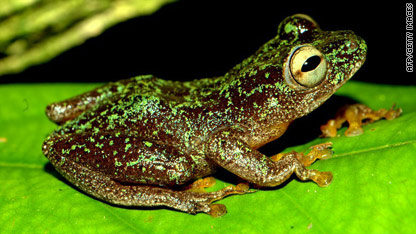 The Omaniundu reed frog hadn’t been observed since 1979
Three species of amphibians thought to be extinct for decades have been rediscovered, scientists announced Wednesday.
The three are the cave splayfoot salamander from Mexico, the Mount Nimba reed frog from the Ivory Coast and the Omaniundu reed frog from the Democratic Republic of Congo.
The three were found as part of an effort by Conservation International and the Amphibious Specialty Group of the International Union for Conservation of Nature to determine if 100 “lost” amphibian species are really extinct.
“These are fantastic finds and could have important implications for people as well as for amphibians,” said Robin Moore, who organized the Search for the Lost Frogs, the official name of the campaign. The creatures could help in medical research or just in protecting water resources, Moore said.
Several specimens of the salamander, of which only a lone individual was identified in 1941, were found in a system of caves accessible only by a pothole in Mexico’s Hidalgo province, Conservation International said.
 The Mount Nimba reed frog, found by a local scientist in a swampy field near Ivory Coast’s border with Liberia, hadn’t been seen since 1967.
The Omaniundu reed frog hadn’t been observed since 1979. It was spotted in a flooded forest next to a Congo River tributary.
The first phase of the lost frogs project continues until next month when the Convention on Biological Diversity opens in Japan. Scientists hope they’ll have more successes to announce then, but Moore said it’s a tall task.
“These rediscovered animals are the lucky ones – many other species we have been looking for have probably gone for good,” he said.
Precautions needed for alligators in southeast Oklahoma, even in winter

As colder temperatures move into Oklahoma, alligators and other reptiles begin to slow down.
Alligators are found in the far southeast corner of Oklahoma, said Micah Holmes, spokesman for the state Department of Wildlife Conservation. They are sometimes spotted in McCurtain County and occasionally seen in Choctaw, Pushmataha and Le Flore counties.
Oklahoma alligators represent the farthest northwest habitat where American alligators can survive, Holmes said.
“They just don’t make it during the winter because they can’t survive the cold,” he said.
During the winter, alligators go into a type of dormancy called torpor, said Jorge Chavez, supervisor of the herpetarium at the Oklahoma City Zoo.
At the zoo, alligators are offered food all winter, but eventually they stop eating in the coldest part of winter, he said. They eat again when temperatures rise.
Although they have access to a heated pool indoors, most alligators at the zoo prefer to stay outside all year, he said.
In the wild, alligators move less but still are potentially dangerous, Holmes said. Approaching or taunting an alligator is a bad idea, even in cold weather.
“You should treat it the same way you would in July,” he said. “Observe it from a distance. It’s nothing to be scared of, but just use common sense.”
Holmes said any alligator spotted beyond its natural habitat should be reported immediately to wildlife officials.
American Red Cross and American Heart Association Jointly Announce Revised First Aid Guidelines
WASHINGTON, Oct. 18 /PRNewswire-USNewswire/ — The American Red Cross and American Heart Association today announced changes to guidelines for administering first aid. Among the revisions are updated recommendations for the treatment of snake bites, anaphylaxis (shock), jellyfish stings and severe bleeding. The First Aid Guidelines are being published in Circulation: Journal of the American Heart Association.
(Logo: http://photos.prnewswire.com/prnh/20090108/RedCrossLOGO)
(Logo: http://www.newscom.com/cgi-bin/prnh/20090108/RedCrossLOGO)
Volunteer experts from more than 30 national and international organizations joined the Red Cross and the American Heart Association in reviewing 38 separate first aid questions. Experts analyzed the science behind them and worked to reach consensus on the treatment recommendations. Last revised in 2005, these recommendations form the recognized scientific basis for most first aid training around the world.
“It is vital that the first aid community come to consensus and speak in a clear voice on these life and death issues,” said David Markenson, M.D., first aid science advisor to the American Red Cross. “We are proud to help set the standard for first aid training around the globe.”
“Prompt and effective first aid can save lives and prevent many medical situations from worsening, so it’s important that everyone learn about the changes the American Heart Association and American Red Cross have made to the first aid guidelines,” said Jeff Ferguson, M.D., American Heart Association volunteer co-chair of the first aid guidelines writing group.
In looking at the treatment of jellyfish stings, the revised guidelines reaffirm the recommendation to use vinegar to treat the sting. The vinegar neutralizes the venom and may prevent it from spreading. After the vinegar deactivates the venom, immersing the area in hot water for about 20 minutes is effective for reducing pain. The treatment for snake bites has been amended slightly to recommend applying a pressure immobilization bandage to any venomous snake bite, with pressure being applied around the entire length of the bitten extremity.
Under the revised guidelines for treating anaphylaxis, if symptoms persist after a few minutes of giving the patient an epinephrine injection from a prescribed auto-injector and medical help is delayed, the first aid provider can give a second epinephrine injection from a prescribed auto-injector. The guidelines also recommend that the general public not routinely use hemostatic agents (substances used to help stop bleeding) to control bleeding because of significant variability in effectiveness and the potential for adverse effects. Tourniquets and hemostatic agents should be considered alternatives for professional rescuers when direct pressure is not possible or fails to control bleeding.
The expert panel also reaffirmed some key first aid recommendations, including use of aspirin when helping someone experiencing persistent chest pain or discomfort associated with a cardiac emergency. Bystanders should call 9-1-1 and activate the emergency medical services (EMS) system for anyone with chest discomfort. While waiting for EMS personnel to arrive, the person being treated may be advised to chew two low dose baby aspirin or one adult (non-enteric-coated) aspirin, if they are not allergic to aspirin or have had a stroke or recent bleeding.
About the American Red Cross:
The American Red Cross shelters, feeds and provides emotional support to victims of disasters; supplies nearly half of the nation’s blood; teaches lifesaving skills; provides international humanitarian aid; and supports military members and their families. The Red Cross is a charitable organization — not a government agency — and depends on volunteers and the generosity of the American public to perform its mission. For more information, please visit www.redcross.org or join our blog at http://blog.redcross.org
About the American Heart Association:
The American Heart Association is the nation’s oldest and largest voluntary health organization dedicated to fighting heart disease and stroke. Our mission is to build healthier lives by preventing, treating and defeating these diseases – America’s No. 1 and No. 3 killers. We fund cutting-edge research, conduct lifesaving public and professional educational programs, and advocate to protect public health. To learn more or join us in helping all Americans, call 1-800-AHA-USA1 or visit americanheart.org.
IPhone app helps identify reptiles in South Florida
Having trouble telling the difference between a Burmese python and a ball python? There’s an app for that.
The recently released IveGot1 app is a field guide to help identify some of the reptiles slithering around South Florida.
“I wouldn’t have believed years ago, when I started doing this, that the public would be engaged like this,” said Dan Thayer, director of Vegetation and Land Management and invasive species expert at the South Florida Water Management District. “This is an incredibly valuable tool.”
The app was created by researchers at the University of Georgia‘s Center for Invasive Species and Ecosystem Health, working with a team of state and federal environmental agencies, including the South Florida Water Management District and the Florida Fish and Wildlife Conservation Commission.
For now, the app provides information on 15 reptiles in South Florida but the hope is more species will be added and for the list to be regularly updated.
The app is free and available to iPhone 4.0 users. By the end of the year, the app will be compatible with the iPhone 3.0 system, and there are plans to add apps for the Droid and Blackberry.
Besides photos, the app includes information about length, body characteristics, pattern, status (native/non-native/invasive), visual identification tips of the head and where the reptile has been seen in South Florida.
The African Nile monitor — a carnivorous lizard that can grow to 6 feet — is well established in Cape Coral, and sightings are becoming more frequent throughout Miami-Dade County. While some of the reptiles in the app are well established, like the monstrous Burmese python found throughout Everglades National Park, others, such as the green and yellow anaconda, have only been sighted a few times and could easily be misidentified without a field guide.
Non-native reptiles in Florida have become an epidemic. Most are released by pet owners who get bored with or cannot keep massive reptiles that once fit nicely in a tabletop terrarium. In the wild, the reptiles wreak havoc on the native animals they feast upon.
Researchers are quick to cite the case of the massive Nile perch, introduced into Lake Victoria in the 1950s, which caused the extinction or near extinction of several hundred species.
“An individual organism can cause a complete ecological collapse,” said Larry Perez, science communications officer at the Everglades National Park.
Today there are 195 non-native animals in Florida and hundreds more non-native plants.
The app, originally designed to help researchers in the field, will become even more valuable when the public can use it to report sightings from their phones. Because the phones are equipped with GPS and cameras, the exact location and a photo can be transmitted immediately to wildlife officials. That feature is not available now, but its designers hope to make it available by next summer. The hope then is that people who work outdoors will use it when they see unwanted reptiles.
“It’s about getting the lay person involved,” Perez said. “People who deliver mail, work in lawn maintenance or travel a route and see something dead on the road that doesn’t belong here.”
The few successful eradication programs came about because of early intervention and quick response. Just gathering data that show the spread of an invasive species “would be incredibly valuable,” Thayer said.
“This could be an extremely helpful thing people could do,” Thayer said. “Obviously we need more [human] eyes.”
Kids get up close, personal with snakes
Scar, a rat snake, curled down Steve O’Neil’s arm on Friday, flicking his tongue at the group of awed students at Covenant Presbyterian Church. The kids reached out and touched its black scales, as O’Neil explained how rat snakes help keep down the rodent population.
Click to enlarge
Steve O’Neil, with Earthshine Nature Center, holds a king snake as he talks about different types of reptiles to children in the Henderson County Homeschool Association at Covenant Presbyterian Church on Friday.
“They can eat a lot of mice and rats. He’s better than any cat,” O’Neil said.
He cautioned the students not to touch snakes in the wild. Scar, however, is not dangerous to humans.
“He’s harmless,” O’Neil said. “He’s a harmless animal.”
O’Neil, who works with Earthshine Nature Programs in Lake Toxaway, brought 10 of his reptilian friends to visit with students of the Henderson County Homeschool Association. The program was sponsored by Wild South, a North Carolina organization dedicated to bringing knowledge to people to protect natural resources.
As O’Neil worked to unravel Scar from his arm, he stretched the snake out to his full length, about 6 feet.
“Whoa!” came the exclaim from the crowd of kids.
King, an eastern king snake, also made an appearance. O’Neil gave the kids the lowdown on King, too.
“They can eat rattlesnakes and copperheads and other venomous snakes,” O’Neil said. “They’re not affected by the venom.”
Lizards and other snakes were also part of O’Neil’s crew. Some of the reptiles were rare, like Xavier, an albino rat snake, and Indigo, the blue-tongued skink, native to Australia.
“He is a big lizard,” O’Neil said. “He has a blue tongue and if you watch, his tongue will flick out.”
O’Neil told the children about his Eastern box turtle conservation project and how he tracks the turtles in North Carolina. According to his website, the project involves “following several wild eastern box turtles with mark-recapture and radio telemetry techniques in order to learn more about their habits, habitats and interactions with humans and our domestic animals.”
Through Friday’s program, O’Neil hoped to teach students the importance of wildlife to the ecosystem and about conservation. It helps children learn when they can come face-to-face with live critters they usually only see in textbooks, he said.
Unfortunately, O’Neil increasingly sees more and more children suffering from what’s known as “Nature Deficit Disorder,” a term coined by Richard Louv in his book “Last Child in the Woods.”
“There’s a horrible disconnect between us and nature,” O’Neil said. “I see it all the time. We go outdoors less. So I’m taking the outside world to the inside.”
Burlington classroom snake survives 45 years
A snake that called a Burlington classroom home for several decades has died.
Naja, a corn snake, belonged to science teacher Joe Desy at Horace Mann Middle School.
The snake died of natural causes Oct. 6. Desy estimated Naja was about 45 years old, which he said is old by reptile standards.
Desy wrote in an obituary that Naja’s early years were spent ridding Iowa farmlands of small rodents. At about the age of 8, the snake came to the school and was “resident reptile and teacher of all things good and true about snakes.”
Naja lived in the classroom from 1972 until 2002 when Desy retired.